

AffinityImmuno · ELISA Kit
Rituximab (Rituxan®) Pharmacokinetic ELISA
Cat.No
EL-1611-181
1X96 wells
- Reactivity
- Human, mouse, rat
- Detection range
- 100ng/ml - 5ng/ml
- Sample type
- Serum Plasma
- Assay time
- 2.5 hours
- Antigen
- Rituximab (Rituxan)
- Detection minimum
- 5ng/ml
Product Overview
This Rituximab (Rituxan®) ELISA kit is designed to measure Rituximab with high specificity and enhanced sensitivity. Rituximab is a chimeric monoclonal antibody used in the treatment of diseases characterized by abnormal or excessive B cells.
INTRODUCTION
Rituximab is a chimeric monoclonal antibody used in the treatment of diseases characterized by abnormal or excessive B cells. Rituximab targets CD20, which is expressed on the surface of B cells, to induce apoptosis in B cells and is used in the treatment of leukemia s and lymphomas, some autoimmune disorders, and organ transplant. A quantitative method for rituximab has been developed and optimized for pharmacokinetic assessment of samples.
The Rituximab ELISA kit is designed to measure Rituximab with high specificity and enhanced sensitivity. The assay design utilizes a pair of antibodies that allows the detection of the whole Rituximab molecule in biological matrices.
PRINCIPLE OF THE ASSAY
This assay employs the sandwich enzyme immunoassay technique. Anti- Rituximab is coated onto a 96 well microplate. Calibrator, quality control samples (if desired) and test samples are pipetted into the appropriate wells. Rituximab present in biological matrices is bound by the immobilized anti- Rituximab antibody. After washing away any unbound substances, enzyme linked anti- Rituximab antibody is added to the wells. This antibody is developed and purified specifically against truncated Rituxan® (domain residing in Fc portion of the Rituxan® molecule). The plate is washed to remove any unbound antibody-enzyme reagent and a substrate solution is added to the wells for color development. The color development is proportional to the amount of Rituximab present in test samples. The color development is stopped and the intensity of the color is measured.
Specifications
- Gene ID
- 931
- Reactivity
- Human, mouse, rat
- Detection range
- 100ng/ml - 5ng/ml
- Sample type
- Serum Plasma
- Sample volume
- 15ul
- Assay time
- 2.5 hours
- Assay precision
- <10%, <10%
- Storage
- -20C, 1 year
- Size
- 1X96 wells
- Antigen
- Rituximab (Rituxan)
- Detection minimum
- 5ng/ml
- Method
- Direct sandwich ELISA
- Detection method
- Peroxidase / OD450
- Application
- Quantification of Rituximab in biological matrices
- Plate format
- Strip
- Specificity
- Rituximab
- Preservative
- None
Kit Components
- Coated microtiter plate, 96 wells
- Calibrator diluent. - 1.8ml
- Calibrator 12ul
- 10X wash buffer - 25ml
- Assay buffer - 50ml
- 1000X detection reagent - 17ul
- TMB - 12ml
- TMB stop solution - 12ml
- Plate sealers - 3
Assay Information
Reagent preparation
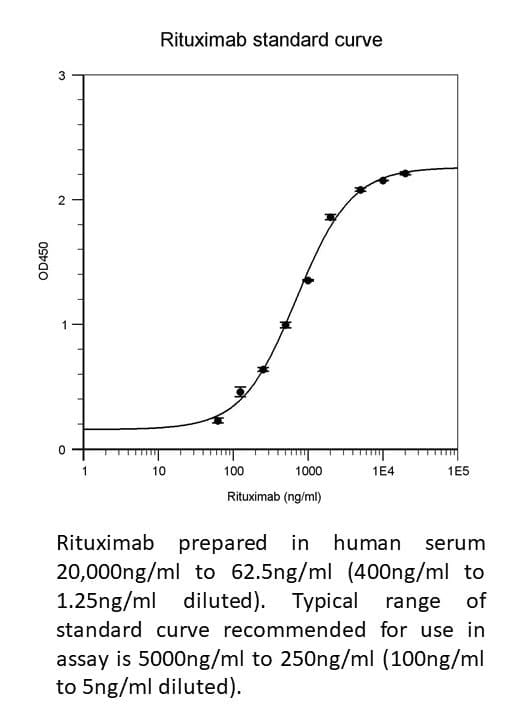
Prepare the appropriate amount of required reagent on the day of use. Store all reagents as per instructions stated on the label. 1. Wash Buffer (1X) Preparation: Dilute wash buffer concentrate with ultra-pure water 1/10 before use (for example add 20mL concentrate to 180mL ultra-pure water). Mix well. 2. Detection Reagent (1X) Preparation: Dilute detection reagent with assay buffer 1/1000 before use (for example add 11μl concentrate to 11ml of assay buffer). Mix well. 3. Preparation of Calibrators: Prepare calibrators with concentrations ranging from 5000 ng/mL to 250 ng/ mL. The following is an example calibrator curve.
Results calculation
1. Construct a standard curve by plotting the absorbance obtained from each standard against concentration. Use a 4 or 5 parameter curve fit. Alternatively a log-log curve fit may be used. 2. The concentration of the unknowns can be read directly from this standard curve using the absorbance value for each sample. 3. Any sample undiluted or diluted still reading greater than the highest standard should be diluted appropriately with assay buffer and retested. If the samples have been diluted, the concentration determined from the standard curve must be multiplied by the dilution factor.
Sample collection
This kit is compatible with EDTA-plasma, heparinplasma and serum samples. Samples can be stored at or below -20°C for up to 1 year.
Sample preparation
Dilute calibrators and test samples 1/50 with assay buffer (for example add 5µL of prepared calibrator or sample to 245µL of assay buffer). Mix well. *Note that test samples may require further dilution when peak values are predicted to exceed 5ug/ml. Do not store diluted samples.