

AffinityImmuno · ELISA Kit
Etanercept (Enbrel®) Pharmacokinetic ELISA Kit
Cat.No
EL-1611-051
1X96 wells
- Reactivity
- Human, mouse, rat
- Detection range
- 50ng/ml - 1.56ng/ml
- Sample type
- Serum Plasma
- Assay time
- 2.5 hours
- Antigen
- Etanercept (Enbrel)
- Detection minimum
- 1.5ng/ml
Product Overview
Etanercept (Enbrel®) is a protein drug used to treat autoimmune diseases by adsorbing tumor necrosis factor (TNF; a soluble inflammatory cytokine).
INTRODUCTION
Etanercept (trade name Enbrel®) is a protein drug used to treat autoimmune diseases by adsorbing tumor necrosis factor (TNF; a soluble inflammatory cytokine). Etanercept is a fusion protein produced through expression of recombinant DNA by linking the extracellular ligand-binding portion of TNFRSF1B to the Fc component of human immunoglobulin G1 (IgG1). It reduces the effect of naturally present TNF, functioning as a decoy receptor that binds to TNF.
Etanercept is indicated for the treatment of moderate to severe rheumatoid arthritis (RA), psoriatic arthritis, ankylosing spondylitis, and moderately to severely active polyarticular juvenile idiopathic arthritis. Serum concentration of ENBREL® may predict some clinical outcome during maintenance therapy.
PRINCIPLE OF THE ASSAY
This assay employs the sandwich enzyme immunoassay technique. Capture antibody is coated onto a 96 well microplate. Calibrator and test samples are pipetted into the appropriate wells. Etanercept present in biological matrices is bound by the immobilized anti-Etanercept antibody. After washing away any unbound substances, enzyme linked anti-Etanercept antibody is added to the wells. The plate is washed to remove any unbound antibody-enzyme reagent and a substrate solution is added to the wells for color development. The color development is proportional to the amount of Etanercept present in test samples. The color development is stopped and the intensity of the color is measured.
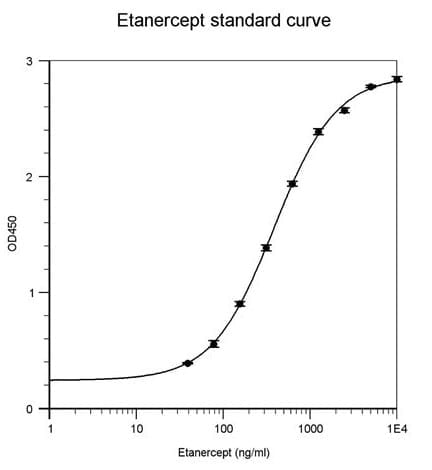
Etanercept prepared in human serum from 10,000ng/ml to 39.06ng/ml then diluted 1 in 50 in Assay Buffer (200ng/ml to 0.78ng/ml diluted). Typical range of standard curve recommended for use in assay is 2,500ng/ml to 78ng/ml (50ng/ml to 1.56ng/ml diluted).
Specifications
- Gene ID
- 7124
- Reactivity
- Human, mouse, rat
- Detection range
- 50ng/ml - 1.56ng/ml
- Sample type
- Serum Plasma
- Sample volume
- 15ul
- Assay time
- 2.5 hours
- Assay precision
- <10%, <10%
- Storage
- -20C, 1 year
- Size
- 1X96 wells
- Antigen
- Etanercept (Enbrel)
- Detection minimum
- 1.5ng/ml
- Method
- Direct sandwich ELISA
- Detection method
- Peroxidase / OD450
- Application
- Quantification of Etanercept in biological matrices
- Plate format
- Strip
- Specificity
- Etanercept
- Preservative
- None
Kit Components
- Coated microtiter plate, 96 wells
- Calibrator diluent. - 1.8ml
- Calibrator 12ul
- 10X wash buffer - 25ml
- Assay buffer - 50ml
- 1000X detection reagent - 17ul
- TMB - 12ml
- TMB stop solution - 12ml
- Plate sealers - 3
Assay Information
Reagent preparation
Prepare only the appropriate amount of required reagent on the day of use. Store all reagents as per instructions stated on the label. 1. Wash Buffer (1X) Preparation: Dilute wash buffer concentrate with ultra-pure water 1/10 before use (for example add 20mL concentrate to 180mL ultra-pure water). Mix well. 2. Detection Reagent (1X) Preparation: Dilute detection reagent with assay buffer 1/1000 before use (for example add 11μl concentrate to 11ml of assay buffer). Mix well. 3. Preparation of Calibrators: Prepare calibrators with concentrations ranging from 2500 ng/mL to 78 ng/mL. The following is an example calibrator curve.
Results calculation
1. Construct a standard curve by plotting the absorbance obtained from each standard against concentration. Use a 4 or 5 parameter curve fit. Alternatively a log-log curve fit may be used. 2. The concentration of the unknowns can be read directly from this standard curve using the absorbance value for each sample. 3. Any sample undiluted or diluted still reading greater than the highest standard should be diluted appropriately with assay buffer and retested. If the samples have been diluted, the concentration determined from the standard curve must be multiplied by the dilution factor.
Sample collection
This kit is compatible with EDTA-plasma, heparinplasma and serum samples. Samples can be stored at or below -20°C for up to 1 year.
Sample preparation
Dilute calibrators and test samples 1/50 with assay buffer (for example add 5µL of prepared calibrator or sample to 245µL of assay buffer). Mix well. Do not store diluted samples.