

AffinityImmuno · ELISA Kit
Rituximab (Rituxan®) Immunogenicity ELISA Kit
Cat.No
EL-141-181
1X96 wells
- Reactivity
- Human, mouse, rat
- Detection range
- 62.5ng/ml - 7.8ng/ml
- Sample type
- Serum Plasma
- Assay time
- 3.5 hours
- Antigen
- Rituximab (Rituxan) Immunogenicity
- Detection minimum
- 7.8ng/ml
Product Overview
Rituximab ELISA Rituxan ELISA immunogenicity Biosimilars
INTRODUCTION
Rituximab (Rituxan® ) is a chimeric mouse/human monoclonal antibody used for treating B cell malignancy, autoimmune conditions, and graft rejection by depleting B cells from the body. This immunogenicity assay employs the bridging ELISA technique. Four levels of QC samples give a qualitative reference signal which can be used to determine the level of anti- Rituximab antibody in the unknown samples. The color development is stopped and the intensity of the color is measured.
PRINCIPLE OF THE ASSAY
This immunogenicity assay employs the bridging ELISA technique. Capture antibody is precoated onto a 96 well microplate. Quality control and test samples are pipetted into the appropriate wells. Anti- Rituximab present in biological matrices is bound by the immobilized capture antibody. After washing away any unbound substances, secondary antibody is added to the wells and after a final wash a detection reagent is added. The plate is washed to remove any unbound antibody-enzyme reagent and a substrate solution is added to the wells for color development.
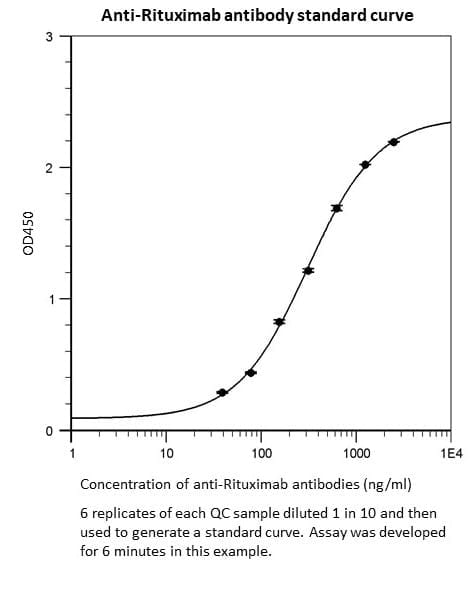
The color development is proportional to the amount of anti-Rituximab present in test samples. Three levels of QC samples give a qualitative reference signal which can be used to determine the level of anti-Rituxumab antibody in the unknown samples. The color development is stopped and the intensity of the color is measured.
Target background
Rituximab (Rituxan® ) is a chimeric mouse/human monoclonal antibody used for treating B cell malignancy, autoimmune conditions, and graft rejection by depleting B cells from the body. This immunogenicity assay employs the bridging ELISA technique.
Specifications
- Gene ID
- 931
- Reactivity
- Human, mouse, rat
- Detection range
- 62.5ng/ml - 7.8ng/ml
- Sample type
- Serum Plasma
- Sample volume
- 15ul
- Assay time
- 3.5 hours
- Assay precision
- <10%, <10%
- Storage
- -20C, 1 year
- Size
- 1X96 wells
- Antigen
- Rituximab (Rituxan) Immunogenicity
- Detection minimum
- 7.8ng/ml
- Method
- Bridging ELISA
- Detection method
- Peroxidase / OD450
- Application
- Quantification of antibodies to Rituximab
- Plate format
- Strip
- Specificity
- Anti-Rituximab antibodies
- Preservative
- None
Kit Components
- Coated microtiter plate, 96 wells
- QC samples - 4x50ul
- 10X wash buffer - 25ml
- Assay buffer - 50ml
- 1000X secondary antibody - 17ul
- 1000X detection reagent - 17ul
- TMB - 12ml
- TMB stop solution - 12ml
- Plate sealers - 3
Assay Information
Reagent preparation
Prepare only the appropriate amount of required reagent on the day of use. Store all reagents as per instructions stated on the label. 1. Wash Buffer (1X) Preparation: Dilute wash buffer concentrate with ultra-pure water 1/10 before use (for example add 2mL concentrate to 18mL ultra-pure water). Mix well. 2. Secondary antibody (1X) Preparation: Dilute secondary antibody with assay buffer 1/1000 before use (for examples add 12μl concentrate to 12ml of assay buffer). Mix well. 3. Detection Reagent (1X) Preparation: Dilute detection reagent with assay buffer 1/1000 before use (for example add 12μl concentrate to 12ml of assay buffer). Mix well.
Results calculation
1. Because anti-drug antibodies will vary in terms of affinity and concentration, this assay provides a qualitative readout. As such the user should use the comparable positive controls when comparing interassay results. The provided controls are tested for comparability between lots and can be traced. 2. The anti-drug antibody titers in the test samples will fall in the range of high, medium, low or negative. We recommend each lab develop their own statistical cutpoint using methodologies as described by G. Shankar, et al. (2008). (Recommendations for the validation of immunoassays used for detection of host antibodies against biotechnology products. J. Pharmaceutical and Biomedical Analysis 48:1267–1281). 3. Any sample undiluted or diluted still reading greater than the highest standard should be diluted appropriately with assay buffer and retested. If the samples have been diluted, the concentration determined from the standard curve must be multiplied by the dilution factor.
Sample collection
This kit is compatible with EDTA-plasma, heparinplasma and serum samples. Samples can be stored at or below -20°C for up to 1 year.
Sample preparation
Dilute QC samples and test samples 1/10 with assay buffer (for example add 30µL of prepared calibrator or sample to 270µL of assay buffer). Mix well. Do not store diluted samples. If test samples are out of range, then they may be further diluted.